





PROJECT DESCRIPTION
Concentrix: Making agentic AI unmistakably human
Concentrix: Making agentic AI unmistakably human
Concentrix is a global technology company working with over 2,000 brands worldwide. They help organisations design and deliver customer experiences that combine human insight with emerging technology. As Experience Design Director, my role involved leading strategic innovation initiatives that shaped our approach to AI-enabled customer experiences.
Concentrix is recognised for delivering customer support solutions and designing and building digital products and services for its clients. We map customer journeys, remove friction, and optimise for conversion. Our design practice excels at creating experiences where humans maintain full control over their interactions.
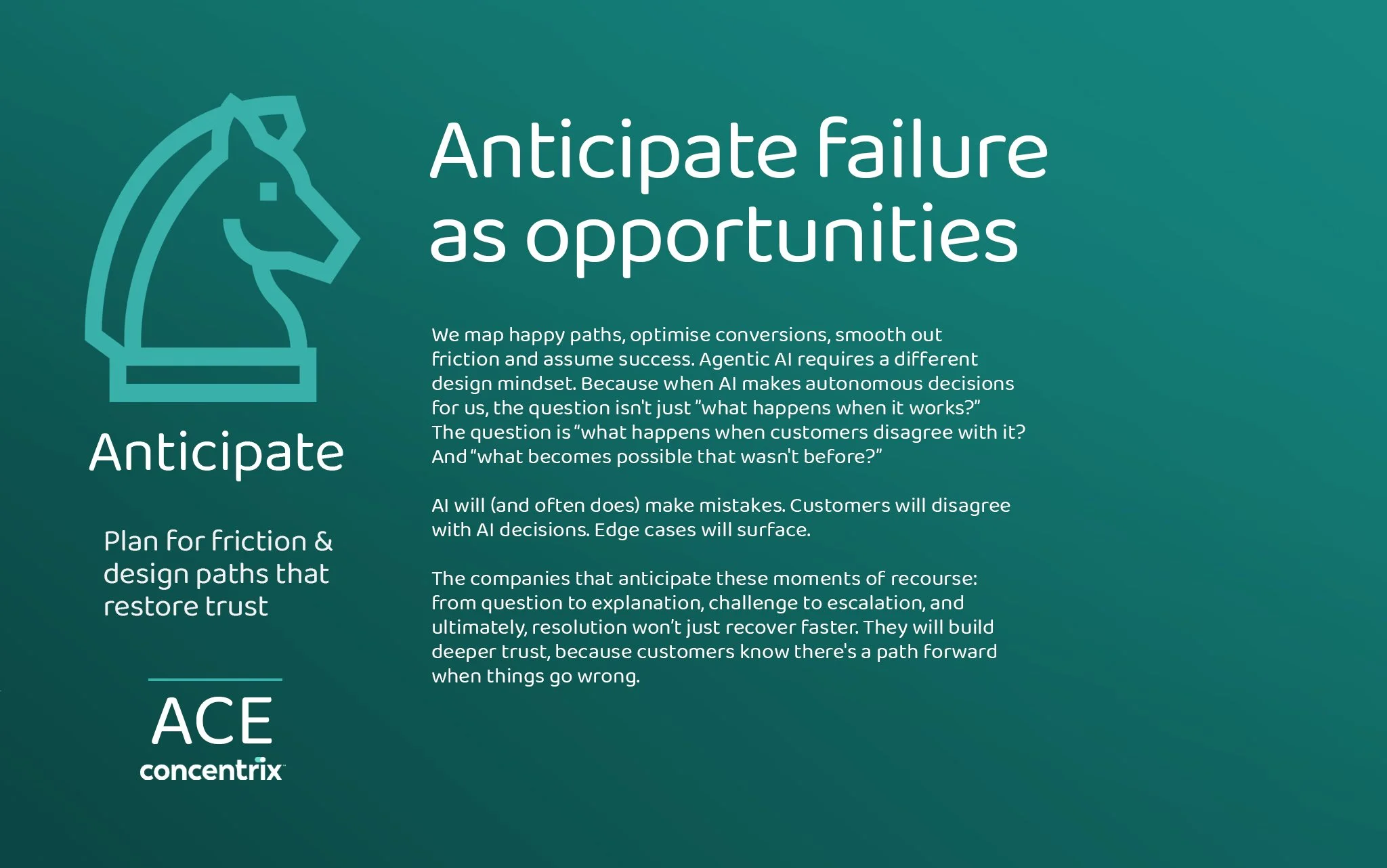
But agentic AI breaks the traditional UX design playbook.
Across the industry, everyone agrees AI should be designed to ensure technology serves people—not the other way around. However, we hadn’t yet defined how to design autonomous systems that preserve human dignity while delivering real value. As Global Design Practice Lead, I recognised that while we had the Agentic Operating Framework™ for operationalising AI, we were missing the experience layer. Lacking a clear methodology, we needed new tools to deliver human-centred, AI-powered experiences.
Traditional CX frameworks were built for transactional interactions that optimise individual touchpoints across one journey. Agentic AI, however, changes this dynamic: customers aren't just using a tool, but are delegating agency to systems that can orchestrate actions across multiple journeys. These systems can learn and improve over time, become contextually aware and hyper-personalised with each interaction, and—by maintaining continuous relationships—blur the boundaries between personal and professional contexts.
Therefore, the design challenge shifted. The focus moved from simply making systems easy to use to making customers trust AI enough to let it act on their behalf. The old frameworks weren’t equipped to address:
· Dignity when AI fails
· Agency when AI decides
· Trust when AI acts autonomously
· Relationships that span months and years
I understood that resistance emerges when AI feels intrusive, unclear, or reduces personal control. Without agentic experience design, even technically excellent AI would be rejected, exposing a fundamental truth: technical readiness isn’t the same as customer readiness. Companies that focus solely on operational efficiency risk losing millions if they neglect to consider how users feel about delegating agency to AI. They would see trust break, adoption stall, and customers abandon systems that feel undignified or controlling. A new framework was needed to address this gap.
I initiated this project to create the experience design methodology our practice needed to deliver Agentic customer experiences that people want in their lives, not the ones they fear. The framework needed to:
· Provide practical design principles for agentic AI across industries and maturity stages.
· Balance the protection of human dignity and agency with transformational value.
· Be immediately actionable for cross-functional teams.
· Support commercial conversations with premium brand CX leaders.
· Position Concentrix at the forefront of agentic experience design.
The challenge involved distilling complex research on AI trust, human agency, and relational design into a clear narrative that explained the value proposition and created a repeatable methodology to guide real implementation decisions.
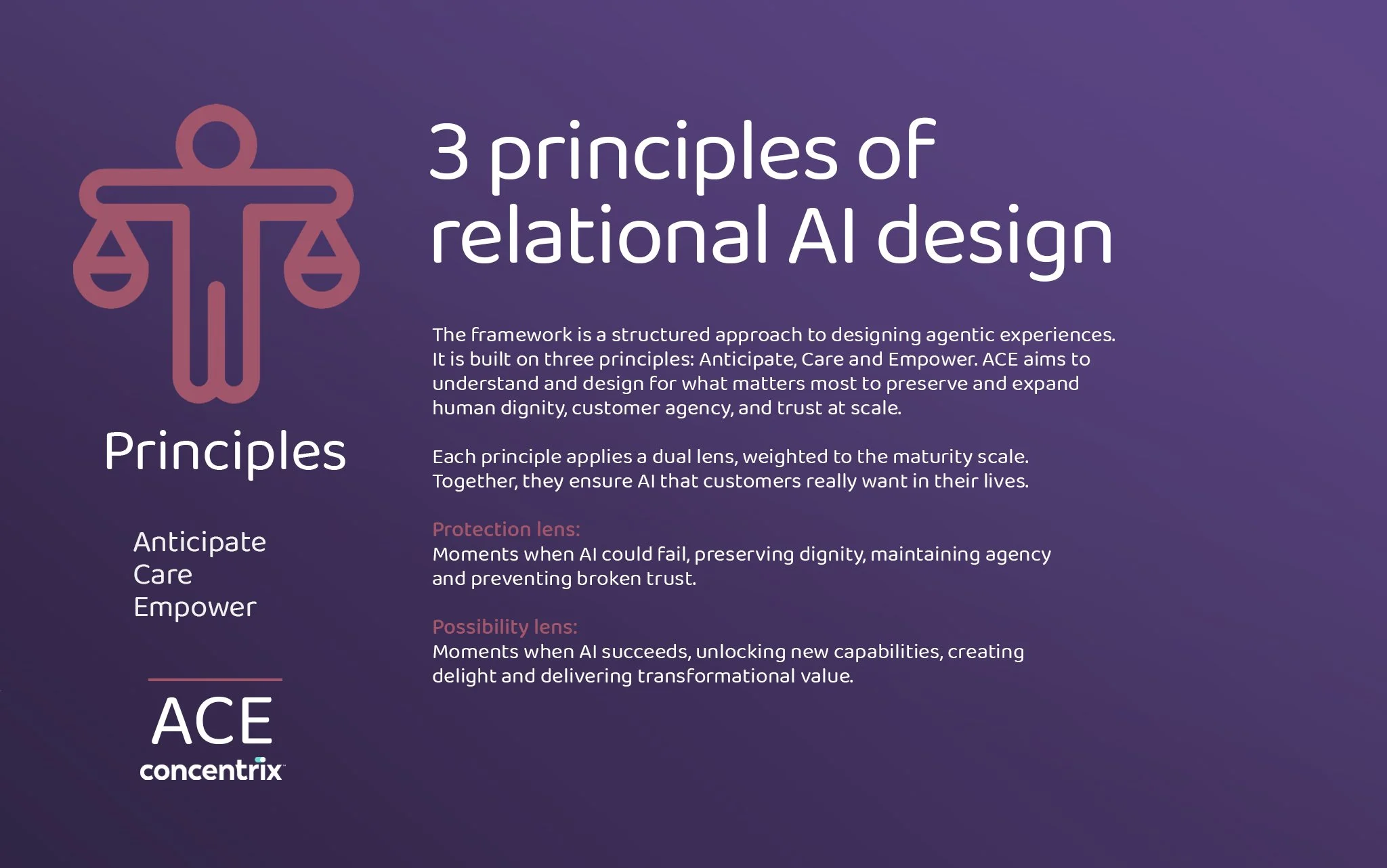
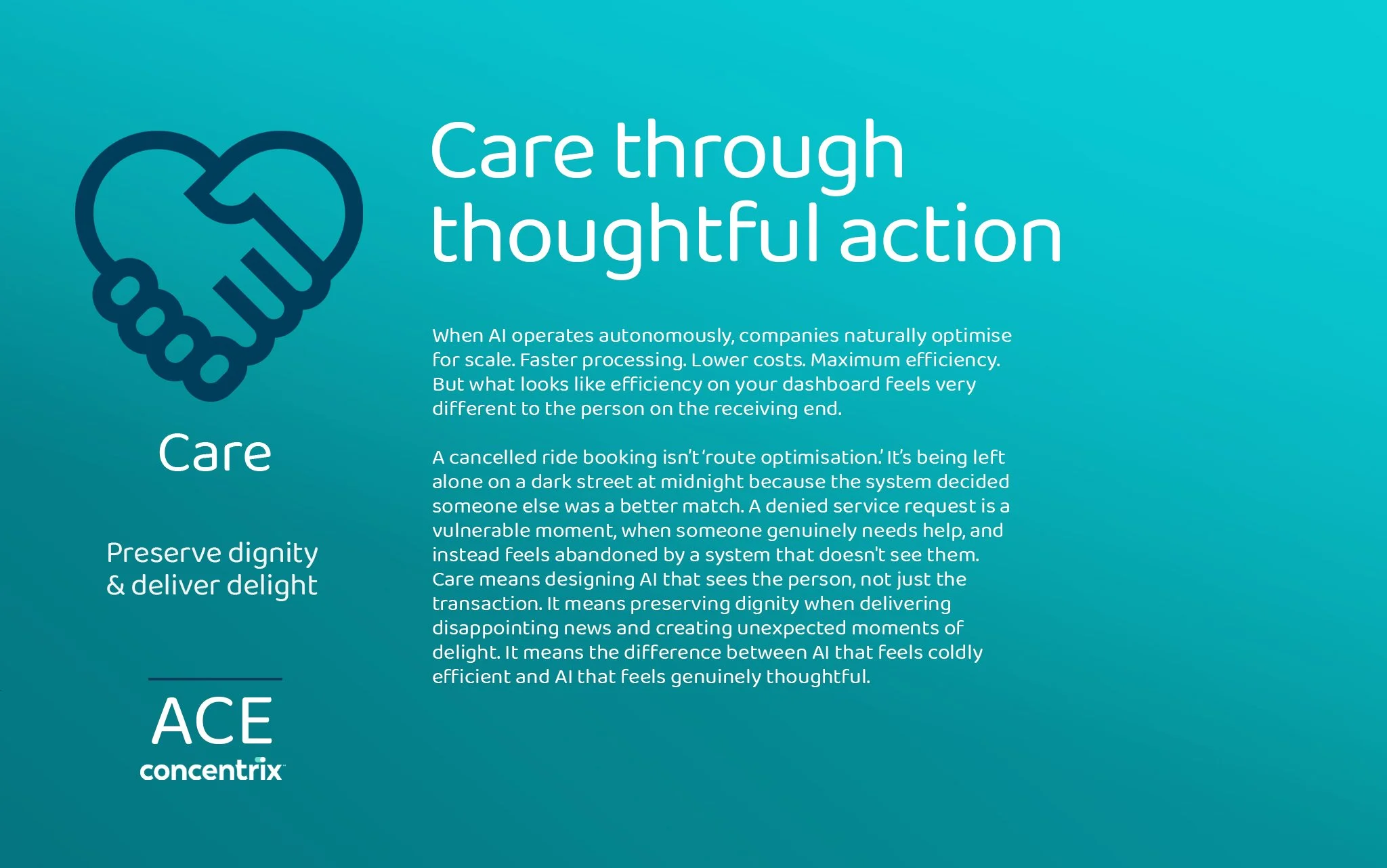
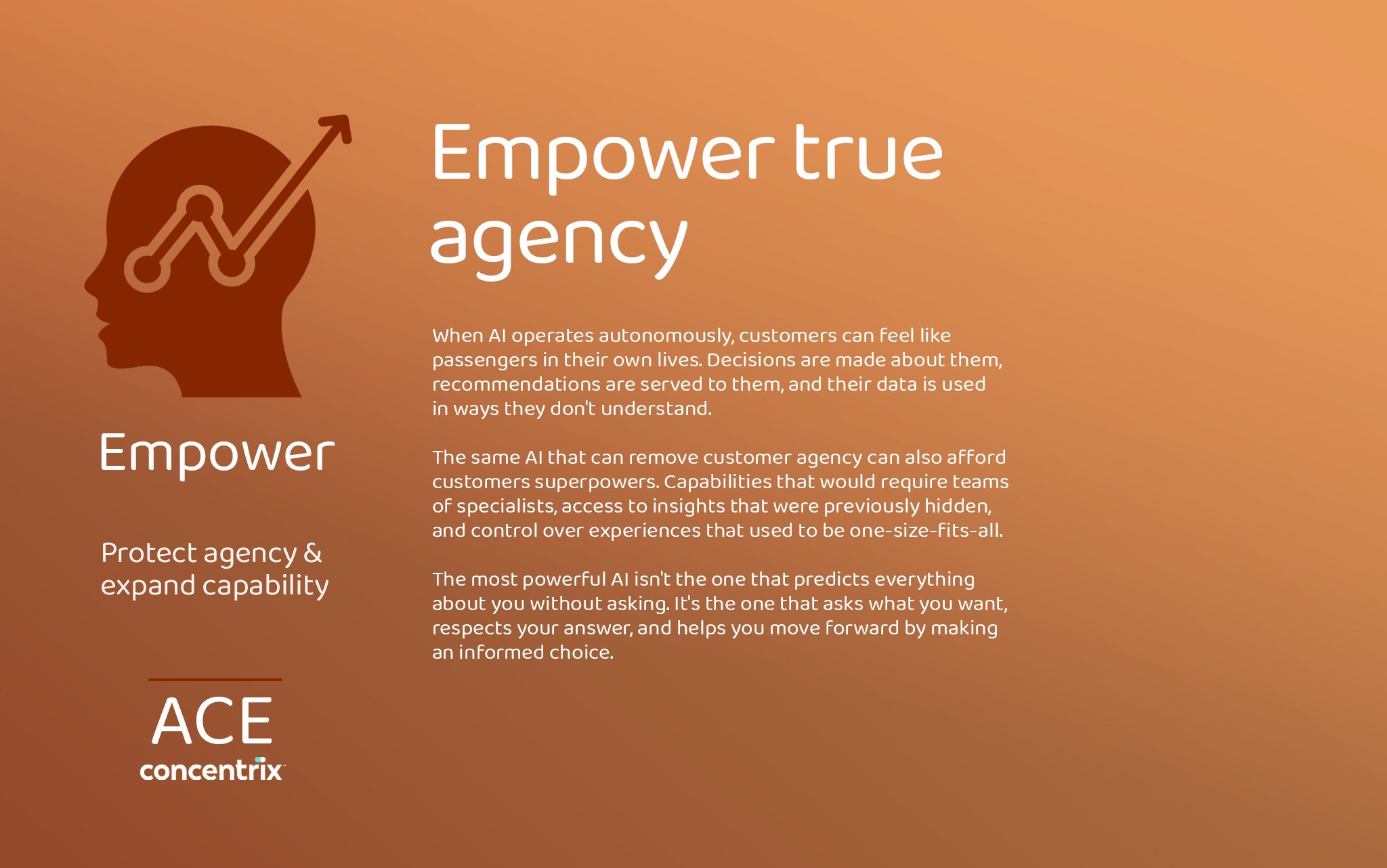
Over the course of six weeks, I developed the Agentic Experience Framework, which is built on three key principles: Anticipate, Care, and Empower (ACE).
Each principle applies a dual lens. Protection addresses moments when AI could fail, preserving dignity, maintaining agency, and preventing broken trust. Possibility addresses moments when AI succeeds, unlocking capabilities, creating delight, and delivering transformational value.
I started by synthesising research on AI trust and examining case studies of failed AI adoption. I analysed emerging patterns in autonomous systems design and identified where existing frameworks fell short.
Working with AI (Claude & GPT) as thinking partners, I stress-tested concepts and refined the framework structure. I then mapped how ACE principles would manifest across industries—banking, retail, transport, and utilities—and defined how the framework adapts to four AI maturity stages, from early-stage tools requiring protection-heavy design, to advanced autonomous agents emphasising possibility-first approaches. I created a scoping survey and discovery workshop outline to facilitate pre-sales discussions and comprehensive documentation, including:
· Framework principles with protection and possibility dimensions
· Industry-specific applications showing ACE in context
· Maturity stage guidance for appropriate ACE emphasis
· Two-phase deliverable structure (audit/mapping, then design/implementation)
· Team role definitions across seven specialist positions
The framework enables organisations to design autonomous AI experiences that users will actively trust and want to engage with. By fostering trusted relationships, ensuring customer adoption, and delivering positive, reliable brand interactions, ACE addresses real pain points in deploying agentic AI.
This work represents the culmination of an exploration of AI's role in design practice. I contributed to Concentrix's thought leadership on empathetic AI, articulating how to build interfaces between human complexity and computational logic. Read the full guide here. From that foundation, I developed ACE as a new value proposition that translates complex concepts about AI trust, dignity, and agency into a commercially viable offering, enhancing The Operating Framework™ by making agentic AI adoption more successful, differentiated, and aligned with client priorities on trust and experience.
Together, both frameworks ensure operations and experience are designed as one. Technical constraints shape the possibilities of experience, and experience requirements drive technical decisions.
The strategic impact of ACE:
· Addresses the critical gap between technical AI capability and human adoption, providing a commercial answer to the 95% failure rate plaguing AI initiatives.
· Establishes new vocabulary and methodology for agentic experience design, moving industry conversation from principle to practice.
· Creates the methodology our design practice needs to work with autonomous systems, extending our capabilities beyond traditional UX.
· Creates shared language between technical and experience teams, bridging a communication gap that often derails AI projects.
· Provides client-facing teams with a structured approach for premium CX engagements, directly connecting experience design to AI ROI.
The development of the Agentic Experience Framework marks a pivotal shift in how Concentrix approach the design of autonomous systems. By centring human dignity, agency, and trust at every stage, ACE empowers organisations to create AI-powered experiences that are not only technically advanced but also genuinely embraced by users. As AI continues to evolve, frameworks like ACE will be essential in bridging the gap between innovation and adoption.
The real craft in designing for autonomous systems lies in the details: how AI signals its limitations, how smoothly it transitions to human care, how it maintains dignity throughout interactions. ACE provides the methodology to get those details right, turning principles into practice at scale.
“I think it’s brilliant and very relevant in terms of content, because when we talk about agentic AI, we talk a lot about data, optimisation and gains, but rarely about the desire to support end users or their fears. So, for me, ACE meets a real need.”
“It is awesome work. Love this as a first strike deck! Does this proposition land? Yes!”